
Finance & Business
WhatsApp Business Charges Explained: Is WhatsApp Business Free for Businesses?
The standard WhatsApp Business mobile app is free to download and use. However, businesses using the WhatsApp Business Platform, Meta’s solution for larger-scale business messaging, can incur charges for certain messages.

by Maxwell Nnawuihe | Published: August 29, 2026
WhatsApp Business Charges: Is the App Really Free?
For many small businesses, freelancers, entrepreneurs and online sellers, WhatsApp is more than a messaging app. It has become a convenient way to communicate with customers, answer questions, promote products and maintain relationships.
That naturally raises an important question:
Does WhatsApp Business cost money?
The short answer is: it depends on which WhatsApp business product you are using.
The standard WhatsApp Business mobile app is free to download and use. However, businesses using the WhatsApp Business Platform, Meta’s solution for larger-scale business messaging, can incur charges for certain messages.
Understanding this distinction can prevent confusion and help business owners choose the right setup for their needs.
WhatsApp Business App vs WhatsApp Business Platform
One of the biggest sources of confusion is treating these two products as if they are the same.
They are not.
1. WhatsApp Business App
The WhatsApp Business app is designed primarily for small businesses and individual business operators.
It provides features that can help a business manage everyday customer communication, including:
- Business profiles
- Product or service catalogues
- Automated greetings
- Away messages
- Quick replies
- Labels for organising conversations
- Direct customer communication
For many small businesses, this may be all they need.
The app itself is free to download and use.
However, businesses still need an internet connection, and normal mobile-data charges from their network provider may apply.
ALSO READ:
- The Ultimate Guide to Budgeting Tools for Business and Personal Growth
- 10 Free Tools for Managing Your Online Side Hustle—Faith And Fortune Finance
- Entrepreneurship: Building Ideas into Impact in Today’s Economy
- FG Offers Free CAC Business Registration for 250,000 MSMEs
- Nigeria’s Business Climate in 2026: Survival Strategy, and Growth in a Tough Economy
2. WhatsApp Business Platform
The WhatsApp Business Platform is intended for businesses that need more advanced messaging capabilities and larger-scale customer communication.
This can be particularly relevant to businesses that want to connect WhatsApp with systems such as:
- Customer-support platforms
- Marketing systems
- E-commerce services
- Customer relationship management tools
- Automated communication systems
- Business software
Unlike the basic mobile application, the Business Platform operates under Meta’s business messaging pricing structure.
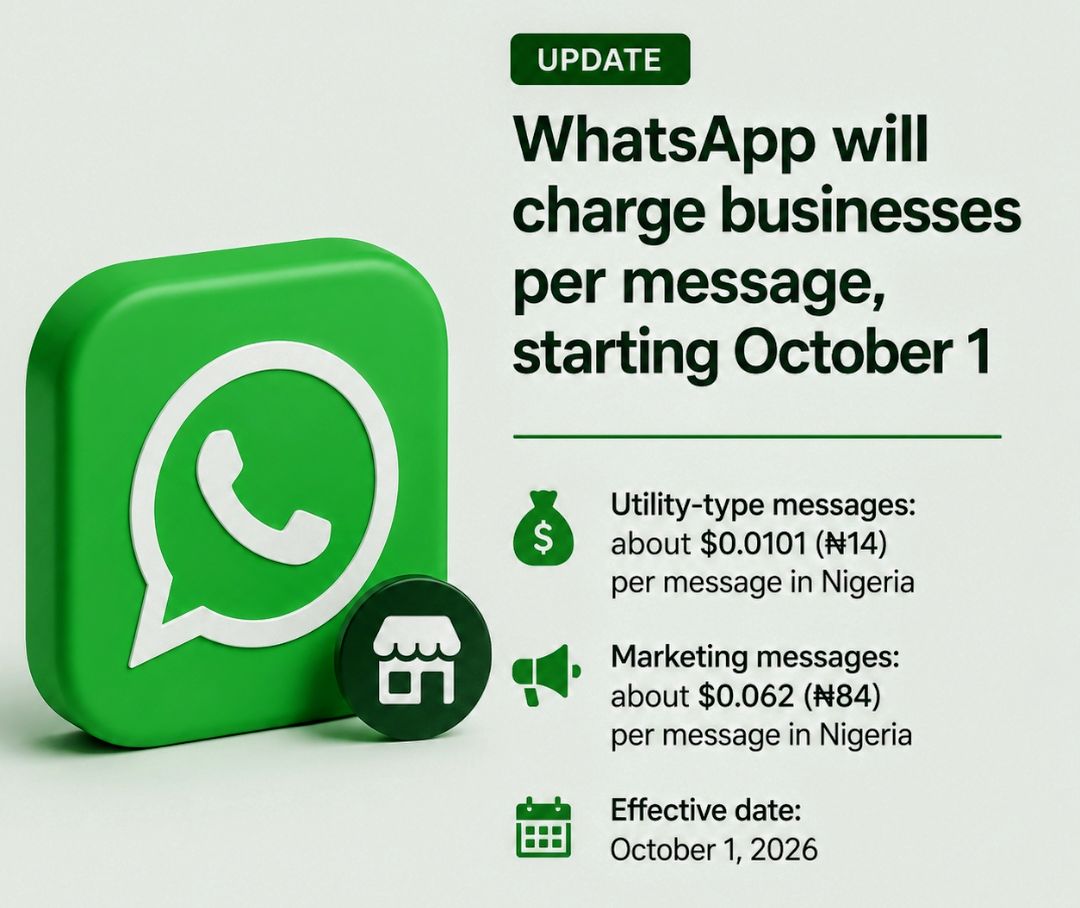
That means businesses can face per-message charges, depending on the type of message and the applicable pricing rules.
So, What Are WhatsApp Business Charges?
The important thing to understand is that there is no single universal WhatsApp Business charge for every business.
Costs can depend on factors such as:
- The WhatsApp product being used
- The type of business message
- The destination market
- The applicable pricing category
- Whether a conversation is initiated by the customer or the business
- Meta’s current pricing structure
This is why business owners should avoid relying on an old WhatsApp pricing screenshot or an outdated social-media post.
WhatsApp business pricing can change.
Before making financial decisions, businesses should check the current pricing applicable to their account and market.
Why Does Meta Charge Businesses for WhatsApp Messaging?
At first glance, some business owners may wonder why a messaging service that feels free to consumers can generate costs for businesses.
The answer lies in the difference between ordinary personal communication and commercial-scale communication.
A business may use messaging infrastructure to communicate with hundreds, thousands or even millions of customers.
That can involve:
- Message delivery infrastructure
- Business authentication
- Automation
- Customer-service systems
- Application integrations
- Large-scale communication
- Commercial messaging tools
The Business Platform is therefore designed as a commercial communication service rather than simply a free messaging application.
Does Every WhatsApp Business Message Cost Money?
No—not every WhatsApp Business interaction should be assumed to have the same cost.
Meta’s business messaging model distinguishes between different types of business conversations and messages.
For example, a customer-initiated conversation can be treated differently from certain business-initiated messages.
This distinction matters because a business that communicates strategically may have a very different messaging bill from a business that sends large volumes of promotional communication.
The lesson is simple:
Don’t calculate your WhatsApp costs by counting every message and applying one universal price.
The applicable pricing rules matter.
A Simple Example for a Small Business
Imagine a small online business selling clothing.
The owner receives questions such as:
“Is this product available?”
“How much is delivery?”
“Can I order this size?”
If the business uses the standard WhatsApp Business app, it can manage these conversations without paying Meta a per-message WhatsApp Business Platform fee simply for using the app.
The business may still incur internet or mobile-data costs.
Now imagine that the same company grows substantially and begins using automated systems to communicate with a large customer base through the WhatsApp Business Platform.
Its cost structure can change.
At that stage, the company needs to understand Meta’s applicable business messaging charges and monitor its communication volume.
WhatsApp Business Charges and Nigerian Businesses
For entrepreneurs in Nigeria, understanding the difference between the free app and the Business Platform is particularly useful.
Small businesses often operate with tight margins.
An unexpected technology bill can therefore affect profitability.
Before adopting a more advanced messaging system, a business owner should consider:
Customer volume
How many customers actually need to be contacted?
Message volume
How many business messages are sent each month?
Automation needs
Does the business genuinely need automated or large-scale communication?
Customer service
Would a simple WhatsApp Business workflow be sufficient?
Profit margin
Can the additional communication cost be justified by additional sales or customer retention?
These questions can prevent businesses from paying for infrastructure they do not yet need.
Free Does Not Mean Cost-Free
There is another important distinction.
When people say that the WhatsApp Business app is “free,” they generally mean that there is no purchase price for downloading and using the standard app.
But running a business through WhatsApp can still involve other costs.
For example:
- Internet data
- Smartphones
- Staff time
- Customer-service personnel
- Advertising
- Product photography
- Order management
- Payment processing
- Website or e-commerce infrastructure
Therefore, WhatsApp may be free as an application while the overall business operation around it is not free.
That is an important point for anyone preparing a business budget.
Is WhatsApp Business Worth It for Small Businesses?
For many small businesses, WhatsApp can be a highly practical customer-communication channel.
Its biggest advantage is not simply that the basic app is free.
It is that customers are already familiar with messaging.
A business can use that familiarity to make communication easier.
For example, a small entrepreneur could use WhatsApp Business to:
- Answer customer questions
- Display products
- Confirm orders
- Provide updates
- Respond to complaints
- Maintain customer relationships
The key is to use the platform as part of a broader business strategy rather than treating it as the entire business.
How Businesses Can Control WhatsApp Communication Costs
Businesses using advanced WhatsApp messaging tools should treat communication as a measurable business expense.
A simple monthly review can include:
1. Number of customers contacted
2. Number and type of business messages sent
3. Revenue generated from WhatsApp leads
4. Customer-support volume
5. Conversion rate
6. Cost per customer acquired
This creates a more useful question than simply asking:
“How much does WhatsApp charge?”
The better question is:
“How much value does WhatsApp generate compared with what the business spends on it?”
WhatsApp Business and the Customer Experience
Cost should not be the only consideration.
Customers generally want communication that is:
- Useful
- Timely
- Relevant
- Respectful
- Easy to understand
Sending too many promotional messages can damage customer relationships.
A business might therefore reduce unnecessary messaging while improving the quality of the communication it does send.
For example, instead of sending five promotional messages in a short period, a business could focus on one useful update that genuinely helps customers.
Better communication can improve trust.
And trust can become a valuable business asset.
Christian Perspective: Use Technology as a Steward
For Christian entrepreneurs, technology can also be viewed through the principle of stewardship.
The question is not simply whether a platform is free or paid.
It is whether the resource is being used wisely and responsibly.
Luke 16:10 teaches the principle of being faithful with little before being entrusted with more.
That principle can apply to business technology.
An entrepreneur can ask:
- Am I spending wisely?
- Does this tool genuinely serve my customers?
- Am I communicating honestly?
- Am I respecting customers’ time?
- Is the technology helping me serve people better?
From this perspective, digital tools become instruments rather than idols.
Secular Business Perspective: Measure the Return
From a conventional business perspective, the calculation is equally practical.
Every business tool should ultimately be evaluated according to its usefulness.
If WhatsApp helps generate qualified leads, close sales, retain customers or reduce customer-service costs, the platform may provide significant business value.
If a company spends money on messaging but generates little measurable benefit, it may need to reconsider its strategy.
This is the principle of return on investment (ROI).
Faith and secular business thinking can therefore arrive at a similar conclusion:
Use resources wisely.
Common Misunderstandings About WhatsApp Business Charges
Myth 1: “WhatsApp Business is completely paid.”
Not necessarily. The standard WhatsApp Business mobile app is free to download and use.
Myth 2: “Every WhatsApp Business message costs the same.”
Not necessarily. Business Platform pricing depends on the applicable messaging rules and categories.
Myth 3: “Using WhatsApp Business means there are no business costs.”
Not necessarily. Data, staff, advertising and other operational expenses can still apply.
Myth 4: “The free app and Business Platform are identical.”
They serve different business needs and should not be treated as the same product.
RELATED ARTICLES:
- Africa’s Business Future Starts in Nigeria—Tracking Times
- Business Is War, War Is Business — Faith, Strategy & Survival in 2025
- The 2026 Funding Revolution: How Accountability and Bionic Strategy Unlock Global Capital for African MSMEs
- Entrepreneurship: The Rise of AI-Native Soloist and the Human Edge
Final Verdict: Is WhatsApp Business Free?
For most small-business users, the answer is yes when referring to the standard WhatsApp Business mobile app.
However, businesses using the WhatsApp Business Platform need to understand Meta’s applicable business messaging charges.
The smartest approach is therefore not to ask only whether WhatsApp Business is free.
Instead, ask: Which WhatsApp business solution does my business actually need?
For a small entrepreneur handling customer conversations manually, the free app may be sufficient.
For a growing company requiring sophisticated automation, integrations and large-scale customer messaging, the Business Platform may make more sense—but its costs should be included in the company’s operating budget.
Ultimately, the goal is not simply to find the cheapest communication tool.
It is to find a communication system that helps a business serve customers, control costs and grow sustainably.
Key Takeaways
- The standard WhatsApp Business mobile app is free to download and use.
- The WhatsApp Business Platform has a separate commercial pricing structure.
- Business Platform messaging can involve per-message fees.
- Pricing can depend on message type, market and applicable Meta rules.
- Internet and other business operating costs can still apply when using the free app.
- Small businesses should choose their WhatsApp solution according to their actual needs.
- Businesses should monitor messaging expenses and compare them with measurable results. Pricing information should always be checked against Meta’s latest applicable terms because business messaging prices can change.
Editorial Note
WhatsApp Business products and commercial messaging prices can change. Businesses should verify the current terms applicable to their account and market before making purchasing or budgeting decisions.
Intellectual Property & Content Protection Notice
© 2026 TrackingTimes.co All rights reserved.
This publication, including its text, structure, analysis, headlines, and original reporting, is protected under applicable international copyright laws.
No portion of this article may be copied, reproduced, modified, republished, distributed, scraped, translated, or stored in any retrieval system without the express written consent of TrackingTimes.co.
Content scraping, AI training usage, unauthorized reposting, or monetized reproduction is strictly prohibited and may attract civil and criminal penalties.
For syndication or licensing requests, contact: trackingtimes@gmail.com