
Finance & Business
Dangote Refinery Boosts Domestic Production & Transforming Nigeria Fuel Market
Dangote Refinery has been supplying an average of more than 40 million liters of petrol to local markets daily, registering about 62% of total petrol consumption in the country.

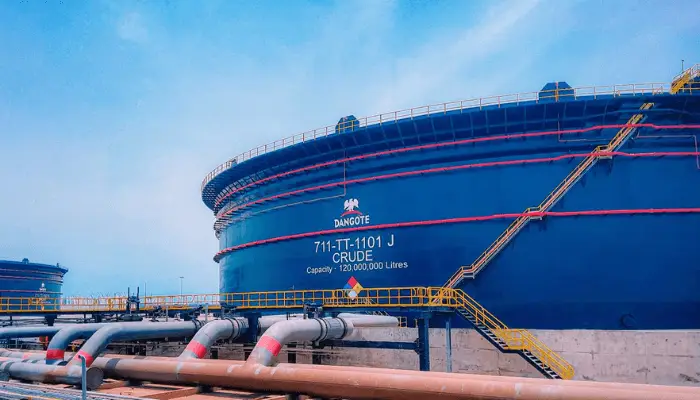
How Dangote Refinery Is Reshaping Domestic Production and Fuel Supply in Nigeria
Nigeria’s energy landscape is set to transform fundamentally as the country’s vast oil reserves fuel local manufacturing and boost petrol production to break import dominance. For years, the country has been one of the world’s significant crude oil producers, unable to refine its vast oil reserves for local consumption. Instead, the country has depended on imported Premium Motor Spirit and other petroleum products, relying mainly on foreign refiners and marketers to meet its huge domestic demand.
The 650,000 barrels per day (bpd) Lekki mega refinery is now helping to increase domestic refining to record levels and reshape Nigeria’s fuel supply landscape.
Shifting Domestic Production and Fuel Consumption Pattern – NMDPRA
Based on data published by the Nigerian Midstream and Downstream Petroleum Regulatory Authority (NMDPRA), domestic petrol production has surged to surpass imports for the first time in recent years and is now poised to meet over 60% of local demand in the country.
Notably, the new statistics on petrol allocation and consumption in Nigeria show that:
Dangote Refinery has been supplying an average of more than 40 million liters of petrol to local markets daily, registering about 62% of total petrol consumption in the country. Therefore, petrol imports by marketers and National Petroleum Development Company (NNPCL) have dropped to below 38%, well below the 62% supplied by local refining and downstream processing activities.
The company has opened its production valves to supply up to 50 million liters of petrol daily to local consumers through gatways and coastal sales routes on a demand-supply basis.
Such a surge in local refining and processing has created enormous foreign exchange savings and reduced the country’s reliance on imported petroleum products and foreign refiners, opening the way for more investment in domestic refining and processing. In addition, Nigeria’s foreign exchange reserves are expected to grow substantially due to the impressive volumes of crude oil production and processing in local refineries and manufacturing companies.
Another factor that has propelled the country to scale domestic fuel production and processing is the significant improvement in the domestic crude supply obligation (DCSO) program and policies.
According to reports by the Nigerian Upstream Petroleum Regulatory Agency (NUPRC), domestic production and allocation of crude oil to local refineries have surged to record levels in Q2 2023. Specifically, about 53.7 million barrels of crude oil were delivered to local refineries in the second quarter, compared to lower levels in previous quarters. In addition, Dangote refinery recorded about 52.6 million barrels, or 98%, of supplied crude oil, showing that it is the largest refinery in Nigeria receiving crude oil.
Improved commercial terms and bankable Sales and Purchase Agreements (SPAs) between local oil producers and downstream processors have opened the floodgates for increased crude oil deliveries to domestic refineries and manufacturing companies.
ALSO READ:
- The Strait of Hormuz Closed Again: Why The Chockepoint Returns
- Global News Briefing: The “Energy Ultimatum” and Nigeria’s Internal Frontlines
The increased domestic production and processing of fuel and petroleum products will have several advantages for Nigerian consumers, transporters, and business owners. Some of the benefits of the current trend in the local fuel supply chain include:
Local petrol production will reduce portage and import duties and offset some of the unpredictable fluctuations in international oil prices, which eventually lower the selling price of petrol, diesel, and other petroleum products at the pump.
The significant value of local petrol production and processing will ease the pressure on Nigeria’s foreign exchange reserves, especially since the country is a major oil producer but previously depended on foreign refining companies to process most of its oil.
The massive capacity utilization of the Dangote refinery and other local manufacturing plants and processing facilities will create employment opportunities, boosting the local economy.
With the robust demand for crude oil in the local refining sector, Nigeria may soon become fully self-sufficient in fuel production and processing, eliminating the need to buy fuel from outside sources. In particular, Dangote refinery, with its Crude Distillation and Residual Fluid Catalytic Cracking Units, could play a critical role in local fuel production, achieving full self-sufficiency in petrol production. Such a feat will further position Nigeria as a developed and industrialized nation with cutting-edge manufacturing technologies comparable to those of developed countries in Africa. The impressive domestic crude oil supply volumes and Dangote Refinery’s ability to utilize them for local fuel production and processing will soon make it a reference point for other domestic manufacturers and processors.
What are your thoughts on Nigeria’s impressive domestic fuel supply and production statistics? Are you looking forward to local petrol manufacturing and processing? Let us know your thoughts and opinions in the comments section below. Don’t forget to share this article and follow us across all social for more insightful stories.
Intellectual Property & Content Protection Notice
© 2026 TrackingTimes.co All rights reserved.
This publication, including its text, structure, analysis, headlines, and original reporting, is protected under applicable international copyright laws.
No portion of this article may be copied, reproduced, modified, republished, distributed, scraped, translated, or stored in any retrieval system without the express written consent of TrackingTimes.co.
Content scraping, AI training usage, unauthorized reposting, or monetized reproduction is strictly prohibited and may attract civil and criminal penalties.
For syndication or licensing requests, contact: trackingtimes@gmail.com