
Global Affairs
Trump, Putin and China: What Their Historic Meeting Means for Global Politics and the World Economy
U.S. President Donald Trump, Russian President Vladimir Putin, and Chinese President Xi Jinping have held a historic trilateral meeting in Shenzhen, China, bringing together three major powers whose decisions can influence international security, trade, energy, technology, and the future of global diplomacy.

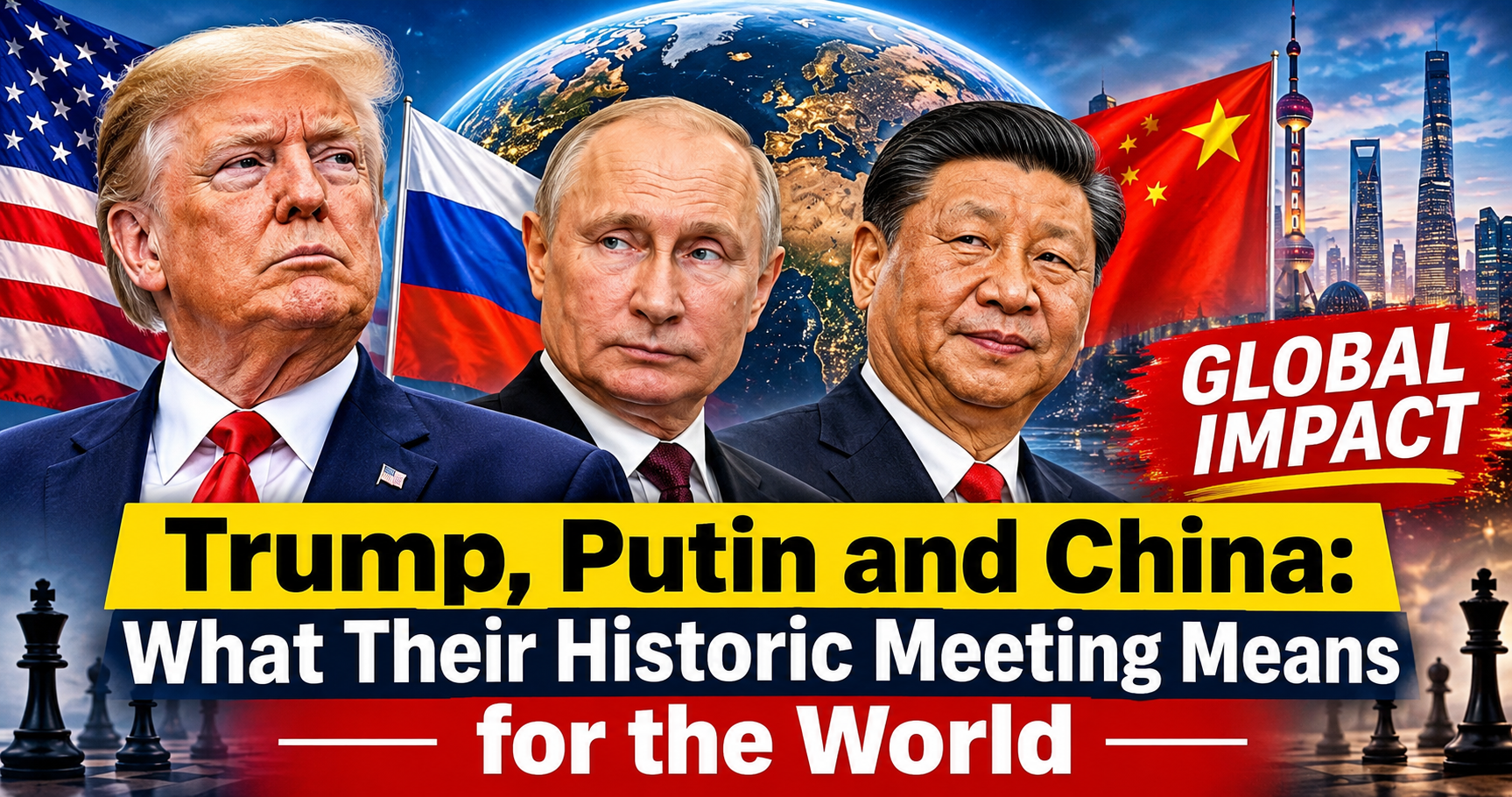
Trump, Putin and China: A Historic Meeting That Could Shape Global Politics

The world is watching as three of the most powerful political leaders meet in China at a time of rising international tensions, economic uncertainty, wars, and competition for global influence.
U.S. President Donald Trump, Russian President Vladimir Putin, and Chinese President Xi Jinping have held a historic trilateral meeting in Shenzhen, China, bringing together three major powers whose decisions can influence international security, trade, energy, technology, and the future of global diplomacy.
The meeting has attracted worldwide attention because the United States, Russia, and China have different national interests, competing strategic priorities, and complicated relationships with one another.
But what does this meeting really mean? Could it open the door to peace, reshape global relationships, or simply become another diplomatic event with more promises than results?
The implications extend far beyond Washington, Moscow, and Beijing. Countries across Africa, Europe, Asia, and the rest of the world could feel the effects of decisions made by these powerful leaders.
Why Trump, Putin and Xi Are Meeting in China
The meeting comes at a time when international relations are increasingly complicated.
The United States is seeking to protect its economic and strategic interests. Russia continues to face international pressure over its war in Ukraine. China is expanding its influence in global trade, technology, diplomacy, and international affairs.
Bringing these three leaders together creates an unusual diplomatic opportunity.
The discussions have involved major issues, including nuclear risks, international security, economic cooperation, and geopolitical tensions. The leaders have also discussed Ukraine, although the summit has not produced a major breakthrough in ending the war.
The meeting is significant because disagreements between these countries can affect the wider world.
When major powers cooperate, markets may respond positively, diplomatic tensions may ease, and opportunities for international cooperation can improve.
When they disagree, the consequences may include trade disputes, economic uncertainty, sanctions, rising security concerns, and increased pressure on smaller nations.
This is why the Trump-Putin-Xi meeting matters even to people who have little direct connection to international politics.
1. Trump’s America: Negotiation, Trade and Global Influence
For Donald Trump, direct negotiations with powerful world leaders have long been central to his approach to international relations.
His administration’s approach places emphasis on negotiations, economic leverage, trade relationships, national security, and the possibility of reaching agreements through direct engagement.
Meeting Putin and Xi gives Trump an opportunity to engage directly on issues that could affect America’s position in the world.
Among the major issues facing the United States are:
- International security and nuclear risks
- Trade relationships with China
- The war in Ukraine
- Relations with Russia
- Global energy markets
- Artificial intelligence and technological competition
Trump’s approach to diplomacy often attracts different opinions. Supporters see direct engagement as an opportunity to negotiate and potentially resolve difficult problems. Critics worry that personal diplomacy can create uncertainty for allies or result in concessions without sufficient guarantees.
The success of the meeting will therefore depend not simply on the photographs or handshakes, but on whether discussions produce agreements that can be implemented and sustained.
2. Putin’s Russia: Breaking Isolation and Pursuing Strategic Interests
For Vladimir Putin, meeting the American president and Chinese leader on the same diplomatic platform is significant.
Russia has faced sanctions, diplomatic tensions with Western countries, and international criticism over its war in Ukraine. A high-profile meeting with the leaders of the United States and China provides Moscow with an opportunity to demonstrate that Russia remains an influential global power.
Putin has several interests that may shape Russia’s diplomatic position:
- Maintaining Russia’s international influence
- Strengthening economic relationships
- Discussing security concerns
- Managing relations with the United States
- Maintaining strategic cooperation with China
- Seeking diplomatic options concerning Ukraine
Russia and China have developed closer economic and political relationships over recent years. However, their relationship does not necessarily mean that both countries have identical interests on every international issue.
For Putin, the meeting is an opportunity to engage directly with two powerful leaders while demonstrating Russia’s continued relevance in global affairs.
Whether that diplomatic visibility translates into meaningful concessions or agreements remains a separate question.
3. China’s Xi Jinping: Expanding Influence Through Diplomacy

China occupies a central position in the global economy.
Its manufacturing capacity, technology sector, international trade, infrastructure investment, and diplomatic relationships make it one of the world’s most influential countries.
For Xi Jinping, hosting Trump and Putin provides an opportunity to present China as a major diplomatic power capable of bringing influential leaders together.
China’s interests may include:
- Protecting economic growth
- Maintaining international trade relationships
- Expanding diplomatic influence
- Managing relations with the United States
- Strengthening strategic ties with Russia
- Promoting its role in global governance
China also has to balance its relationship with Russia against its economic relationships with other countries.
Its approach to diplomacy is therefore likely to involve carefully weighing economic interests, security concerns, and long-term strategic objectives.
The summit offers China an opportunity to strengthen its international image, but global influence also depends on the outcomes of its policies, not just the meetings it hosts.
ALSO READ:
- Economic Policy Policy Nigeria: What Every Voter Must Know
- How to Identify Fake News and Political Manipulation
- Understanding War Through the Eyes of Faith & History
- Top 5 Government Policies Affecting Small Business Owners
4. What Did the Historic Trump-Putin-Xi Meeting Achieve?
The meeting was historic because it brought the three leaders together for their first trilateral summit.
However, the significance of a meeting should be measured by what happens afterward.
The summit’s reported outcomes included discussions and commitments relating to nuclear risks, United Nations reform, international cooperation, and energy supply. But it did not deliver a concrete breakthrough on the major conflicts discussed, and no new agreement ending the war in Ukraine was announced.
This distinction matters.
Diplomatic meetings can establish communication, reduce misunderstandings, and create opportunities for future negotiations. But they do not automatically resolve deeply rooted political or military disagreements.
The world may have witnessed an important diplomatic moment, but the real test will be whether these discussions translate into action.
5. Could the Meeting Affect the War in Ukraine?
The war in Ukraine remains one of the most important issues in international relations.
Any discussion involving Trump and Putin naturally raises questions about whether diplomacy could eventually help reduce the fighting or create conditions for negotiations.
Ukraine’s future is not simply a matter of agreement between Washington and Moscow. Ukraine’s sovereignty, security, territorial concerns, and the wishes of its people remain central to any lasting resolution.
China also has an important diplomatic and economic relationship with Russia, giving Beijing a position that could influence international discussions.
The summit did not produce a publicly announced agreement to end the war. The meeting’s broader diplomatic significance may lie in keeping communication open, although any lasting peace process would require much more than a conversation between powerful leaders.
For millions of people affected by the conflict, the most important outcome would not be political recognition or diplomatic photographs.
It would be a meaningful reduction in suffering, greater security, and a durable peace.
6. What Could This Mean for the Global Economy?

Political meetings between the world’s largest powers can influence economic expectations.
Even without immediate policy changes, diplomatic developments may affect business confidence, international trade, energy prices, currencies, investment decisions, and financial markets.
Trade and business
Improved relations between the United States and China could reduce some trade uncertainty. However, disagreements over tariffs, technology, industrial competition, and strategic interests remain important.
Businesses operating internationally will continue watching for signals about future trade policy.
Oil and energy
Russia remains an important energy producer, while China and the United States are major players in global energy demand and markets.
Changes in diplomatic relationships, sanctions, energy supply agreements, or regional conflicts could affect global oil prices.
That matters for countries like Nigeria, where oil revenues influence government finances, foreign exchange earnings, and economic planning.
Investment
Investors generally prefer predictable environments.
If diplomacy reduces international tensions, it could improve confidence in some markets. But if disagreements intensify, businesses may become more cautious about investment, trade, and expansion.
The summit alone cannot determine the direction of the global economy, but its outcomes may become part of a wider picture that businesses and investors consider.
7. What Does the Meeting Mean for Africa and Nigeria?


Africa is not merely an observer in global politics.
The continent has natural resources, growing populations, developing markets, strategic locations, and increasing importance in global discussions about energy, trade, technology, and economic development.
Nigeria, in particular, has relationships with the United States, China, Russia, and many other countries.
The outcomes of major-power diplomacy could indirectly influence Nigeria through several channels.
Oil prices and government revenue
Changes in international energy markets can affect Nigeria’s oil revenue and foreign exchange earnings.
Trade and imports
China is an important trading partner for Nigeria. Changes in global trade relationships, manufacturing, or supply chains could influence the availability and cost of imported goods.
Foreign investment
Global political stability can influence investor confidence. Businesses may consider diplomatic relationships, security, trade access, and economic policy when deciding where to invest.
African diplomatic influence
African countries have their own national interests. They must engage global powers strategically while avoiding unnecessary dependence on any single international relationship.
The key lesson for Nigeria is that global diplomacy should be viewed through the lens of national interest, economic opportunity, security, and long-term development.
8. Could a New Global Power Balance Be Emerging?

The relationship between the United States, China, and Russia continues to shape international politics.
Some observers believe the world is moving toward a more multipolar system, where several major powers compete for influence rather than one country dominating international affairs.
Others believe the United States will remain the most influential global power, even as China expands its economic and strategic position.
Russia, meanwhile, continues to seek influence through military strength, energy resources, diplomacy, and relationships with other countries.
The Trump-Putin-Xi meeting does not prove that a new world order has been established.
But it highlights the importance of communication between powerful countries whose decisions can affect billions of people.
The most important question is whether this growing competition can be managed through diplomacy or whether it will create further instability.
9. What Should the Rest of the World Watch Next?
The meeting itself is only one part of a much larger geopolitical story.
The following developments may help determine whether the summit produces lasting significance:
- Whether nuclear-risk discussions lead to further negotiations
- Whether the United States and China make progress on trade disputes
- Whether Russia and Ukraine move closer to meaningful negotiations
- Whether diplomatic commitments lead to practical cooperation
- Whether energy markets experience changes following international developments
- Whether smaller countries have their interests protected in major-power discussions
These are the developments worth watching over the coming weeks and months.
A diplomatic handshake may capture the headlines for one day. Policies, agreements, and their implementation are what shape the world for much longer.
10. The Bigger Lesson: Diplomacy Matters, but Actions Matter More
International diplomacy is rarely simple.
Countries can cooperate on one issue while disagreeing sharply on another. Leaders can have friendly personal relationships while their governments pursue competing national interests.
That is why it is important to look beyond political speeches and carefully examine what is actually agreed.
The Trump, Putin, and Xi meeting demonstrates the importance of communication between global powers. It also reminds the world that international relationships are constantly changing.
Peace, economic stability, trade, and security are not guaranteed simply because leaders meet.
They require continued negotiation, trust, accountability, and decisions that consider the consequences for people beyond the negotiating room.
In Conclusion:
The World Is Watching Trump, Putin and China
The historic meeting involving Donald Trump, Vladimir Putin, and Xi Jinping is more than a diplomatic photo opportunity.
It represents an important moment in global politics, bringing together leaders whose countries have enormous influence over international security, trade, technology, energy, and diplomacy.
While the summit has not delivered a major breakthrough on the most difficult conflicts, it has created another opportunity for direct engagement among the world’s most powerful nations.
For the United States, the meeting is an opportunity to pursue its diplomatic and strategic interests.
For Russia, it is an opportunity to demonstrate international relevance and maintain access to high-level diplomacy.
For China, it is an opportunity to reinforce its position as a major global power and diplomatic host.
For the rest of the world, the outcome matters because decisions made by these countries can affect the global economy, security, energy markets, and international relationships.
Ultimately, history will not judge this summit by the number of handshakes, photographs, or statements made.
It will judge it by whether the leaders’ discussions contribute to greater stability, meaningful cooperation, reduced conflict, and a safer future for people around the world.
Intellectual Property & Content Protection Notice
© 2026 TrackingTimes.co All rights reserved.
This publication, including its text, structure, analysis, headlines, and original reporting, is protected under applicable international copyright laws.
No portion of this article may be copied, reproduced, modified, republished, distributed, scraped, translated, or stored in any retrieval system without the express written consent of TrackingTimes.co
Content scraping, AI training usage, unauthorized reposting, or monetized reproduction is strictly prohibited and may attract civil and criminal penalties.
For syndication or licensing requests, contact: trackingtimes@gmail.com