
News & Politics
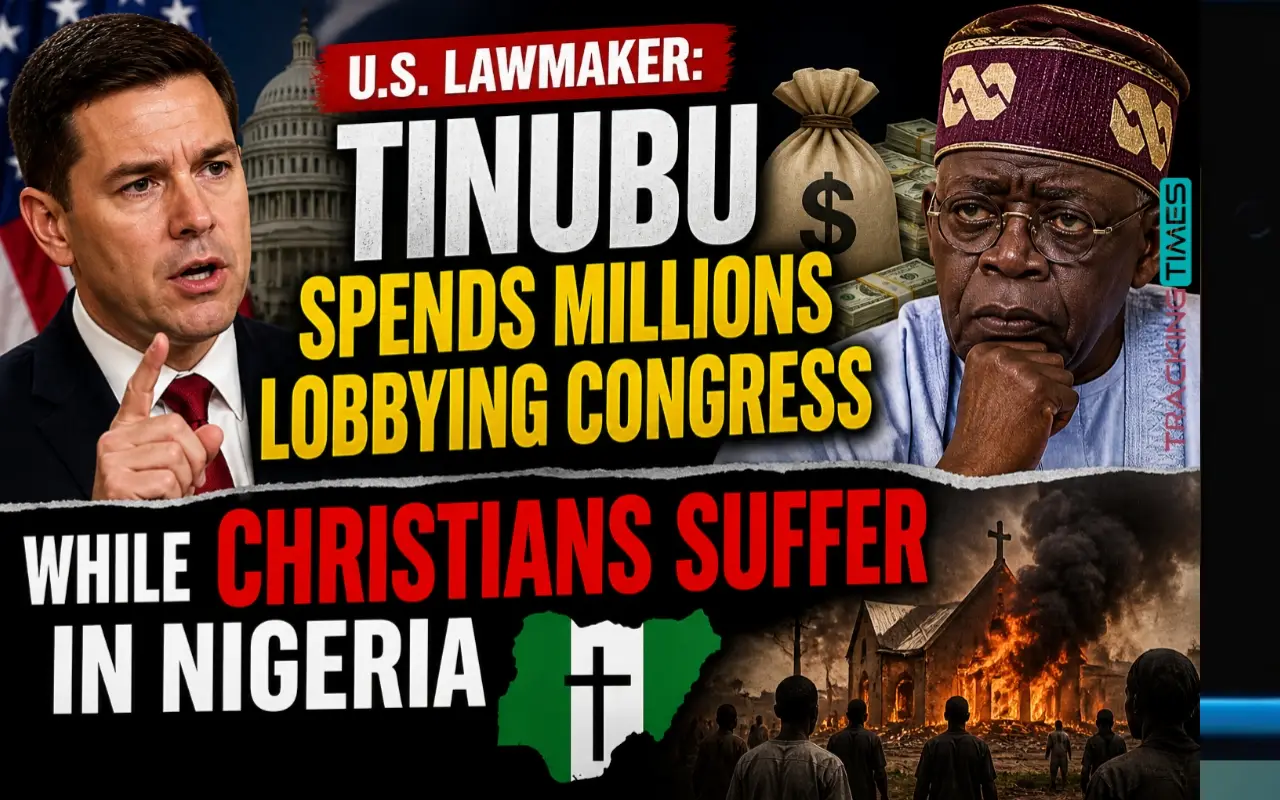
US Lawmaker Criticizes Tinubu’s Lobbying as Congress Moves to Tighten Nigeria Aid Oversight
According to Moore, the proposed appropriations framework would condition U.S. security assistance to Nigeria on measurable actions.

By Maxwell Nnawuihe | May 1, 2026
US Lawmaker Raises Alarm Over Nigeria Policy Direction
A U.S. congressman, Riley M. Moore, has publicly criticized the administration of Bola Ahmed Tinubu, accusing it of spending heavily on lobbying efforts in Washington while failing to adequately address ongoing violence affecting Christian communities in Nigeria.
The remarks, shared in a post on X, come as U.S. lawmakers advance new measures aimed at tightening oversight of American assistance to Nigeria.
Moore’s Statement: Full Context
In his post, Moore wrote:
“The Tinubu Administration is spending millions lobbying Congress while failing to adequately address the genocide Nigerian Christians face daily.”
“@HouseAppropsGOP just passed our annual State Department funding bill which takes serious steps to address this crisis.”
“In this bill, I worked with @MarioDB to restrict Security Assistance to Nigeria unless certain criteria are met, including:
- Effectively responding to violence and holding perpetrators accountable,
- Prioritizing resources for internally displaced persons,
- Actively returning displaced persons to their ancestral homelands”
“It requires @SecRubio to assess Abuja’s compliance with these standards.”
“Further, the law requires that any US assistance prioritizes:
- Atrocities prevention
- Advancing religious freedom
- Prosecuting Fulani ethnic militia groups, criminal gangs, and other jihadist terrorist groups.
- Accountability for police and security forces
- Delivery of humanitarian assistance
- Bolstering faith-based organizations response in areas impacted by violence
- Efforts to disarm Fulani ethnic militants”
ALSO READ:
Tinubu $9 Million US Lobbying Scandal: Denying Christian Genocide in Nigeria?
Unveiling the Shadows: Christian Persecution and Nigeria’s Escalating Insecurity in 2025
“The bill we passed out of committee also adds Nigeria to the list of countries requiring much higher levels of oversight.”
“The Secretary is required to submit a plan for every dollar appropriated to Nigeria, and every dollar spent will have direct Congressional oversight.”
“The bill also includes millions in funding for International Narcotics Control and Law Enforcement to address ‘violence perpetrated by Fulani Ethnic Militia’ and other sources of instability in the Middle Belt.”
“That provision also bolsters support for the establishment of state level police forces so Christians in Plateau and Benue aren’t sitting ducks waiting for help from Abuja.”
“In my view, the Tinubu Administration has failed to live up to the conditions the appropriations committee placed on security assistance.”
“I urge @SecRubio to take this into account in administering both FY26 and FY27 funding.”
“Cracking down on the crisis Christians face in Nigeria has been supported in two appropriations bills by both Republicans and Democrats.”
“The United States will not turn a blind eye to the brutal persecution of our Nigerian brothers and sisters in Christ.”
What the Proposed U.S. Measures Mean
According to Moore, the proposed appropriations framework would condition U.S. security assistance to Nigeria on measurable actions. These include improved accountability for violence, better support for internally displaced persons, and concrete steps toward restoring affected communities.
The legislation also emphasizes broader priorities such as religious freedom, humanitarian aid delivery, and stronger oversight of security forces. It further calls for detailed reporting requirements, meaning U.S. officials would track how every dollar allocated to Nigeria is spent.
Nigeria at the Center of Policy Debate
Nigeria has long faced complex security challenges, particularly in parts of the Middle Belt, where intercommunal violence, criminal activity, and insurgent threats intersect. Communities across different religious and ethnic groups have been affected, with displacement and humanitarian needs continuing to rise.
Moore’s comments reflect a growing debate in Washington about how U.S. foreign assistance should be structured—balancing strategic partnerships with accountability and human rights concerns.
Diplomatic and Political Implications
The criticism of lobbying efforts suggests increasing scrutiny of Nigeria’s engagement strategy with U.S. policymakers. While lobbying is a common practice among governments seeking to influence foreign policy, Moore argues that domestic security outcomes should take priority.
At the same time, the bipartisan support he referenced indicates that concerns about violence and humanitarian conditions in Nigeria are gaining traction across party lines in the United States.
The Road Ahead
If passed into law, the proposed measures could reshape how the U.S. engages with Nigeria on security cooperation, placing stricter conditions on aid and increasing transparency requirements.
For the Tinubu administration, this may signal the need to demonstrate measurable progress in addressing violence, protecting vulnerable communities, and strengthening institutional accountability.
As discussions continue, both governments will likely face pressure to align diplomatic priorities with on-the-ground realities affecting millions of Nigerians.
Intellectual Property & Content Protection Notice
© 2026 TrackingTimes.co All rights reserved.
This publication, including its text, structure, analysis, headlines, and original reporting, is protected under applicable international copyright laws.
No portion of this article may be copied, reproduced, modified, republished, distributed, scraped, translated, or stored in any retrieval system without the express written consent of TrackingTimes.co.
Content scraping, AI training usage, unauthorized reposting, or monetized reproduction is strictly prohibited and may attract civil and criminal penalties.
For syndication or licensing requests, contact: trackingtimes@gmail.com