
Leadership Lessons
Pope Leo African Tour 2026: Bleeding Nigeria Exclusion Explained
The Pope’s decision to fly over Nigeria rather than to it raises uncomfortable issues about the Vatican’s current security priorities. It also prompts reflection on its theological approach to martyrdom.

By Maxwell Nnawuihe | April 18, 2026
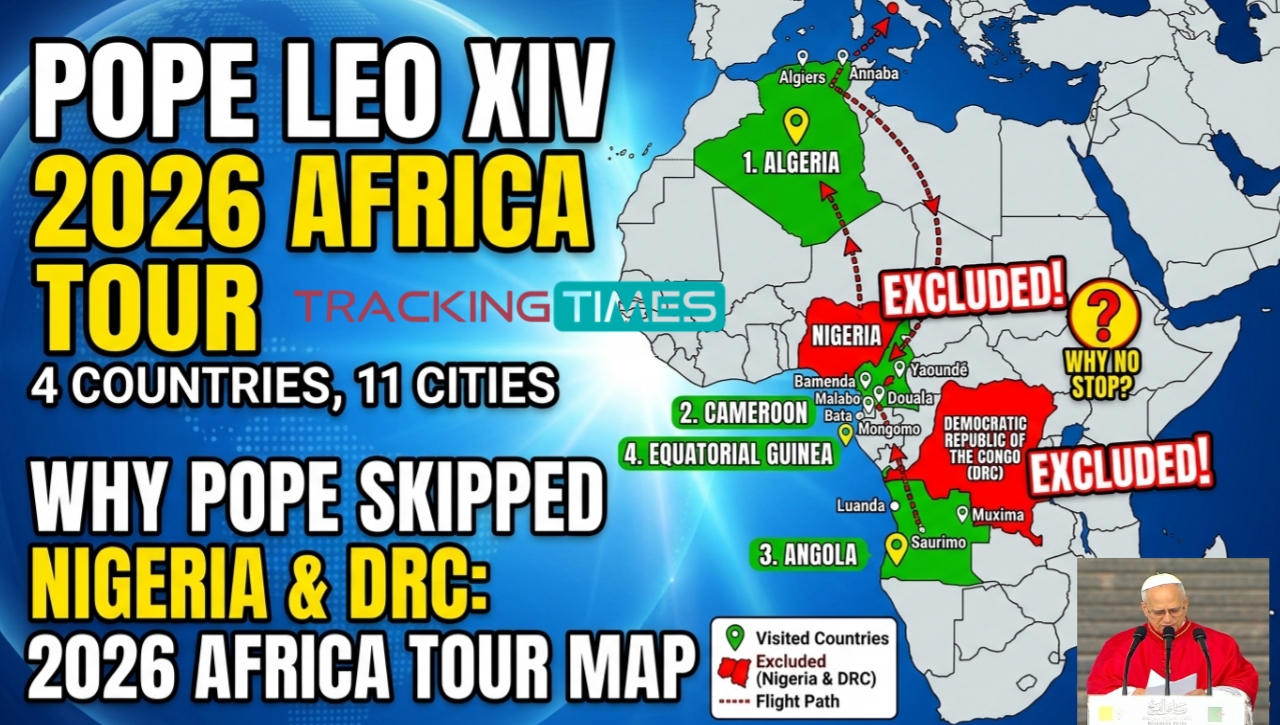
As the Gulfstream carrying the Bishop of Rome touched down in Algiers this week, a palpable sense of abandonment rippled across the Niger River. Pope Leo XIV’s 10-day, four-nation, 11-city apostolic journey is being hailed by the Vatican as a masterclass in “periphery diplomacy.” Yet, for the 35 million Catholics in Nigeria, the itinerary is a glaring, silent void.
Nigeria—the demographic powerhouse of African Catholicism—has been pointedly omitted from a tour that visits Algeria, Cameroon, Angola, and Equatorial Guinea. This exclusion comes at a time when Nigeria has become the undisputed global epicenter of Christian persecution. As jihadist violence, systemic kidnappings of clergy, and the “silent genocide” of farming communities reach a fever pitch in 2026, questions arise. The Pope’s decision to fly over Nigeria rather than to it raises uncomfortable issues about the Vatican’s current security priorities. It also prompts reflection on its theological approach to martyrdom.
The Statistics of Blood: A Nation Under Siege
To comprehend the impact of this exclusion, you need to examine the data. The Vatican undoubtedly reviewed this data before finalizing this tour. According to the Open Doors World Watch List 2026, Nigeria accounted for a staggering 72% of all Christian killings worldwide in the last reporting period. Of the 4,849 Christians murdered globally for their faith, 3,490 were Nigerian.
This is not merely “communal clashing,” as some diplomatic circles suggest. It is a targeted campaign. In the first quarter of 2026 alone, the Diocese of Wukari reported the sacking of dozens of parishes. The Diocese of Makurdi also reported the sacking of dozens of parishes. They also reported the displacement of over 90,000 faithful. For Nigerian Catholics, the “Works of Mercy” aren’t just parables; they are daily necessities for survival in IDP camps.
Father Nathaniel Asuwaye was abducted from the Church of the Holy Trinity in Kaduna just weeks ago. His abduction added to a grim roster of priests. These priests have become high-value targets for ransom and ideological intimidation. In this context, the Pope’s choice to visit Equatorial Guinea—a nation of 1.4 million Catholics—while bypassing a nation with 35 million people experiencing a literal “Great Tribulation” appears to be a strategic retreat.
Watch a video version of this article with balanced analysis
The Security Calculus: Protecting the “Vicar of Christ”
The most immediate and practical reason for the exclusion is the collapse of state capacity in Nigeria. The Vatican’s security detail, the Gendarmerie, operates on a “zero-risk” mandate for papal travel. In 2026, Nigeria’s security architecture is facing a “convergence of threats” from ISWAP, Boko Haram, and increasingly sophisticated Fulani ethnic militias.
The logistics of a papal visit need a “security envelope.” The Nigerian federal government can no longer guarantee this outside of the most fortified zones of Abuja. Unlike Cameroon, where the Pope is visiting Bamenda despite separatist tensions, the Nigerian theater is characterized by unpredictability. In Cameroon, the conflict is regional and political; in Nigeria, the violence is asymmetrical, nomadic, and deeply ideologically motivated.
Vatican sources suggest that the risk of a high-profile “spectacle attack” was unacceptably high. Additionally, a kidnapping attempt on the papal motorcade was a significant concern. However, this raises a theological paradox. Should the successor of Peter, who was martyred himself, prioritize safety? Or should he stand in solidarity with a martyred flock?
ALSO READ:
The “Augustinian” Religious Pivot
Beyond security, there is a religious strategy at play. Pope Leo XIV is a member of the Augustinian Order. His stop in Annaba, Algeria (ancient Hippo), is a personal pilgrimage to the home of St. Augustine. The Vatican is framing this tour as a journey of “Roots and Dialogue.”
The Pope is visiting Algeria, a nation that is 99% Muslim. He aims to position himself as a “Bridge Builder.” This is in response to escalating tensions between the West and the Middle East. The Vatican’s expertise in interfaith diplomacy faces a real test in Algiers. The Pope’s visit to the Great Mosque is intended to counter the “clash of civilizations” narrative.
The concern is regarding the focus on “peaceful coexistence” in Algiers. It comes at the cost of addressing “violent persecution” in Abuja. Nigerian clergy fear the Vatican is practicing “Ostpolitik”. This is a policy of quiet diplomacy and non-confrontation with Islamic powers. The goal is to avoid further inflaming jihadist sentiment in Nigeria. The International Society for Civil Rights and Rule of Law (Intersociety) noted this week. They stated that a “Peace of the Graveyard” is no peace at all.
The EEAT Crisis: Expertise vs. Reality
The Vatican’s “Expertise” (the first ‘E’ in E.E.A.T) in global affairs is often lauded, but its “Experience” on the ground in Nigeria is currently being challenged by its own Bishops. In March 2026, a delegation of Nigerian bishops led by Archbishop Matthew Ndagoso conducted an ad limina visit to Rome. They brought “the cries of their people” directly to Leo XIV. They explicitly countered the Nigerian government’s “false narratives” that the violence is merely about “climate change” or “land disputes.”
The bishops described the reality of a lopsided constitution and the systemic exclusion of Christians from government and security roles. By skipping Nigeria after hearing these testimonies, the Pope inadvertently risks damaging the “Trustworthiness” (the ‘T’ in E.E.A.T) of the Holy See among African Catholics. If the Pope can visit the Great Mosque of Algiers, this raises a concern. He cannot visit the ruins of a razed church in Benue State. The optics suggest a hierarchy of concerns that favors high-level diplomacy over grassroots suffering.
The Authoritative Silence
The Vatican’s “Authoritativeness” comes from its moral clarity. When the Pope visits Cameroon and Equatorial Guinea, these countries are led by long-standing autocrats. He is often expected to speak “truth to power” regarding human rights. However, the omission of Nigeria prevents him from addressing the most powerful government in the region.
Nigeria’s exclusion isn’t just a travel choice; it’s a diplomatic statement. It indicates that either the situation is beyond help from a religious visit. Alternatively, the Vatican might not wish to engage in “confrontational solidarity.” This solidarity is needed to address the genocidal patterns in the Middle Belt.
Conclusion: A Flock Left Fending for Itself?
Pope Leo XIV concludes his 11-city tour in the prisons and hospitals of Equatorial Guinea. The message to the “Super Catholic” states—Nigeria and the DRC—is clear. You are too large to protect. You are too dangerous to visit.
This tour will likely be recorded as a success in the annals of interfaith dialogue. In the parishes of Kaduna and Plateau State, it will be remembered differently. It will be the time the Shepherd stayed in the safe pastures. Meanwhile, the wolves were at the door. The Nigerian Church is resilient. It is the fastest-growing branch of the faith. Even the most resilient branch needs the support of the vine.
For now, the Nigerian faithful must find their own “disarmed peace.” They watch from across the border as a historic opportunity for global intervention flies past them at 30,000 feet.
Intellectual Property & Content Protection Notice
© 2026 TrackingTimes.co All rights reserved.
This publication, including its text, structure, analysis, headlines, and original reporting, is protected under applicable international copyright laws.
No portion of this article may be copied, reproduced, modified, republished, distributed, scraped, translated, or stored in any retrieval system without the express written consent of TrackingTimes.co
Content scraping, AI training usage, unauthorized reposting, or monetized reproduction is strictly prohibited and may attract civil and criminal penalties.
For syndication or licensing requests, contact: trackingtimes@gmail.com