Featured
The Global Arsonist: Mapping the Israel-US-Iran War and the Resurgent Siege on Nigerian Sovereignty
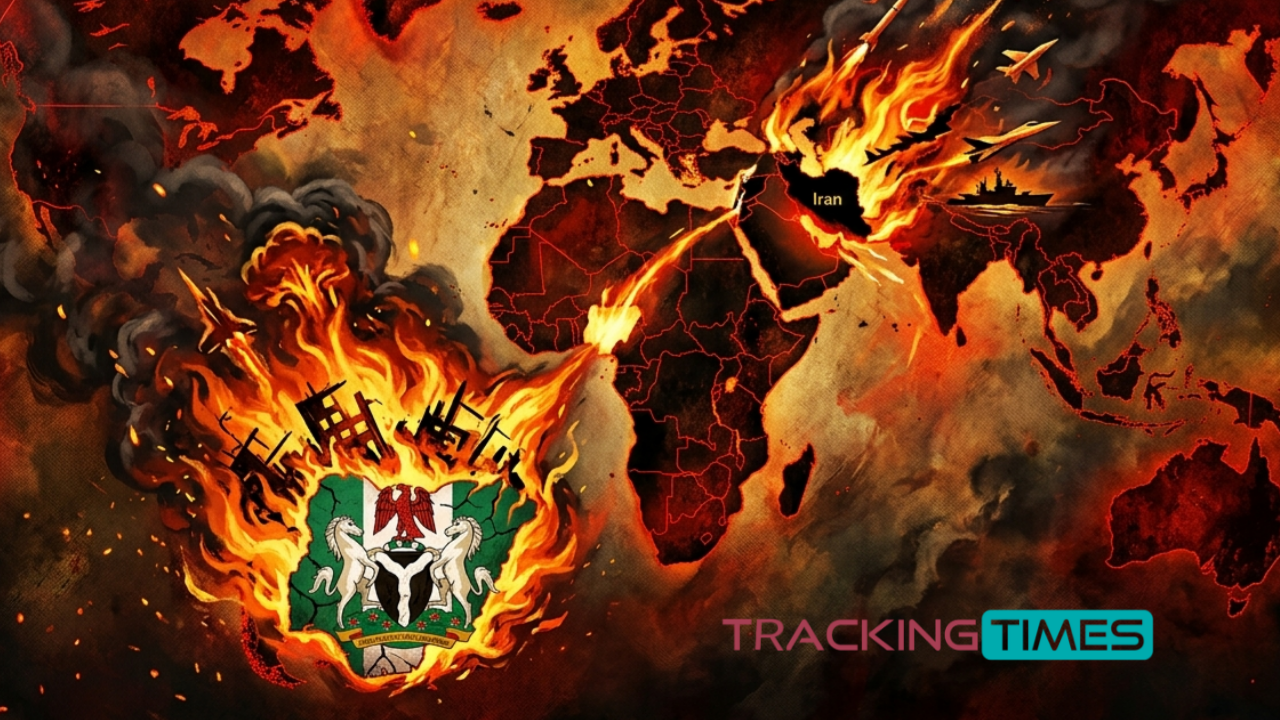
This article examines the current state of the US-Israel-Iran conflict. It also highlights its often ignored counterpart: the ceaseless terrorist attacks continuing to bleed the Nigerian state.

By Maxwell Nnawuihe | Published: March 27, 2026
Introduction: A World Under Siege
The dawn of late March 2026 has brought with it a terrifying clarity. The “Global Village,” once a metaphor for interconnected prosperity, has become an unbroken theater of war. The thread of instability begins with the supersonic precision strikes of Operation Epic Fury in the Iranian heartland. It extends to the devastating, low-tech suicide vests detonated in the markets of Maiduguri.
For the modern leader, the challenge is no longer just surviving a local crisis. It involves navigating a “Polycrisis.” This situation occurs when a drone strike in the Strait of Hormuz influences local economies. It dictates the price of a bag of sachet water in Aba. This article examines the current state of the US-Israel-Iran conflict. It also highlights its often ignored counterpart: the ceaseless terrorist attacks continuing to bleed the Nigerian state.
I. Operation Epic Fury: The End of Strategic Patience
On February 28, 2026, the global security architecture shifted permanently. The United States received direct orders from the White House. These orders joined the US with Israel to launch Operation Epic Fury. This was a massive kinetic campaign. Its goal was to dismantle the Iranian regime’s security apparatus.
As of today, March 27, 2026, the scale of destruction is unprecedented. US Central Command (CENTCOM) has confirmed the death of Admiral Alireza Tangsiri, the commander of the IRGC Navy, in a targeted strike. Reports indicate that over 140 Iranian naval vessels have been incapacitated, and nearly 70% of Iran’s missile launcher array has been eliminated. Israel’s military further announced this morning that it completed a “wide-scale wave of strikes” targeting infrastructure in the heart of Tehran.
However, tactical success has created a Strategic Vacuum. While the Iranian military’s conventional capacity is “knocked out,” the regime has responded with asymmetrical desperation. Debris from intercepted ballistic missiles has killed civilians in Abu Dhabi, and Hezbollah has intensified rocket fire into northern Israel, claiming the lives of several Israeli soldiers this week. We are witnessing a war of attrition where the “front line” is everywhere and nowhere.
II. The 10-Day Pause: A Test of Global Accountability
President Trump made an announcement that has sent shockwaves through global markets. He declared a 10-day suspension of strikes on Iran’s energy facilities. This suspension is effective until April 6, 2026. The Iranian government requested this pause. The White House describes it as a window for “negotiations that are going very well.” This is despite contradictory reports from the ground.
This is a classic study in the Architecture of Silence. While the public hears of “progress,” over 350 vessels remain stranded at the mouth of the Strait of Hormuz. For the Nigerian entrepreneur, this 10-day window is not a period of rest but a high-stakes gamble. If the April 6 deadline passes without a reopening of the Strait, the global “Oil Shock” will transition. It will move from a manageable spike to a structural collapse.
III. The Nigerian Mirror: Maiduguri and the Resurgent Shadow
While global news cycles obsess over “Epic Fury,” a more visceral and “ceaseless” war continues within Nigeria’s borders. On March 16, 2026, the relative calm of Borno State was shattered.
Coordinated suicide bombings—the most devastating in years—struck three high-density locations simultaneously: the Monday Market, the Post Office general area, and the entrance to the University of Maiduguri Teaching Hospital. The death toll has climbed to 27, with over 146 people injured.
This was a deliberate strike on the “sanctity of life” during the holy month of Ramadan. No group has officially claimed responsibility, but authorities point toward the Aliyu Ngulde-led faction of JAS (Boko Haram). This resurgence disproves the idea that the insurgency has been “technically defeated.” It demonstrates that the “Architecture of Silence” in Nigerian intelligence enables deadly urban penetration.
IV. The Ideological Bridge: From Taraba to Tehran
The link between the Israel-Iran war and the Nigerian insurgency is not merely economic; it is ideological. As global tensions rise, domestic extremist groups have intensified their “Point-of-Care” attacks.
On March 23, 2026, St. James the Great Catholic Church in Taraba State was attacked by armed herders in a precise, coordinated strike. This followed a detailed security warning issued just days earlier, which spotted armed groups crossing the Donga River. The fact that the attack occurred despite the warning is a textbook failure of Institutional Accountability.
The “Global Arsonist” uses the distraction of a Middle Eastern war to fuel local fires. Extremist factions now frame their local violence as a “retaliation” for Western actions abroad. This creates a cycle of blood. It bridges the Levant with Lake Chad.
V. The Economic Fallout: Nigeria’s Oil Paradox
The Israel-US-Iran war has created what economists call the “Nigerian Oil Paradox.” The price of Brent Crude has surged past $100. In theory, this should boost Nigeria’s foreign exchange reserves. Instead, the reality for the average Nigerian is a nightmare of “Imported Inflation.”
- The Petrol Crisis: The fuel market is now deregulated. In Abuja and Lagos, pump prices have surged by 55% within three weeks. As of March 25, petrol is selling for as high as N1,371 per litre.
- The Logistics Trap: For MSMEs, the cost of moving goods has doubled. A journey that cost N500 in February now costs N1,000. This is “Transportation Inflation” that hits the poorest Nigerians first.
- The Revenue Gap: Despite high global prices, Nigeria’s production is limited by domestic “theft and vandalism.” As a result, we are missing the windfall. We are still suffering the full weight of the global price hike.
This is a failure of Institutional Accountability. The government is “smiling” at higher Federation Account revenues while households are “gasping” for air.
VI. The Nnamdi Kanu Factor: A Litmus Test for the Rule of Law
In the midst of this security storm, the Nigerian judiciary has reached a definitive crossroads. On November 20, 2025, Mazi Nnamdi Kanu was sentenced to life imprisonment on seven counts of terrorism. Justice James Omotosho decided to show “mercy” instead of imposing the death penalty. He described Kanu as an “international terrorist.” Kanu’s actions outside the law could not be excused.
As we move through 2026, the Kanu case remains a “Litmus Test.” The Nigerian state must prove it can balance national security with the Rule of Law. If the legal process—including the contentious “Extraordinary Rendition” from Kenya—is seen as opaque, this perception undermines “Institutional Integrity.” Such integrity is crucial to fighting a modern insurgency. Accountability is not a “peace-time luxury”; it is the foundation of a stable state.
ALSO READ:
VII. Bionic Leadership: A Strategy for the 2026 Polycrisis
How does a leader navigate a world where the Strait of Hormuz and the Monday Market are both on fire? At TrackingTimes.co, we advocate for Bionic Leadership—the integration of human empathy with high-speed digital strategy.
- Radical Transparency: The “Architecture of Silence” must be dismantled. The Nigerian military must provide real-time, daily briefings on domestic insurgent movements. These briefings should mirror the transparency of CENTCOM’s briefings on Epic Fury, even if selective.
- Technological Sovereignty: As seen in the Taraba intelligence reports, drone surveillance is already spotting armed movements. However, “seeing” is not enough. Bionic leadership requires Response Accountability—the ability to act on data before the church is attacked or the market is bombed.
- Economic Resilience: The 2026 oil shock has pushed petrol prices to record highs. MSMEs must “Hedge for the Worst” by diversifying income streams and utilizing digital assets to combat the Naira’s volatility.
Conclusion: One War, Two Fronts
Whether it is a missile over Tel Aviv or a suicide vest in Maiduguri, there is a common root cause. It is a failure of Institutional Accountability. The world in 2026 is a “Global Village” on fire. We must recognize that the peace of the Middle East is inextricably linked to the peace of the Middle Belt.
Ignoring the ceaseless attacks in Nigeria while obsessing over the “Epic Fury” in Iran addresses only the symptom. Meanwhile, the patient bleeds out. True leadership requires us to hold our institutions accountable on both fronts. We must demand a world where purpose, identity, and security are universal rights. They can no longer be “optional luxuries.”
The Quiz
- What is the new deadline for the US-Iran “Energy Pause”?
- Which Nigerian city recently suffered a triple suicide bombing at its teaching hospital?
- What is the core concept of “Bionic Leadership” discussed in this briefing?
Comment your answer below 👇
Intellectual Property & Content Protection Notice
© 2026 TrackingTimes.co All rights reserved.
This publication, including its text, structure, analysis, headlines, and original reporting, is protected under applicable international copyright laws.
No portion of this article may be copied, reproduced, modified, republished, distributed, scraped, translated, or stored in any retrieval system without the express written consent of TrackingTimes.co
Content scraping, AI training usage, unauthorized reposting, or monetized reproduction is strictly prohibited and may attract civil and criminal penalties.
For syndication or licensing requests, contact: trackingtimes@gmail.com