
Leadership
Aisha’s Confession, Buhari’s Locked Room, the Unanswered Questions of 2017
Aisha Buhari also confessed that the President’s office was bugged, private conversations were replayed to him, and that fear, suspicion, and psychological pressure contributed significantly to his decline, stating that fear and conscience “contributed to taking his life.”

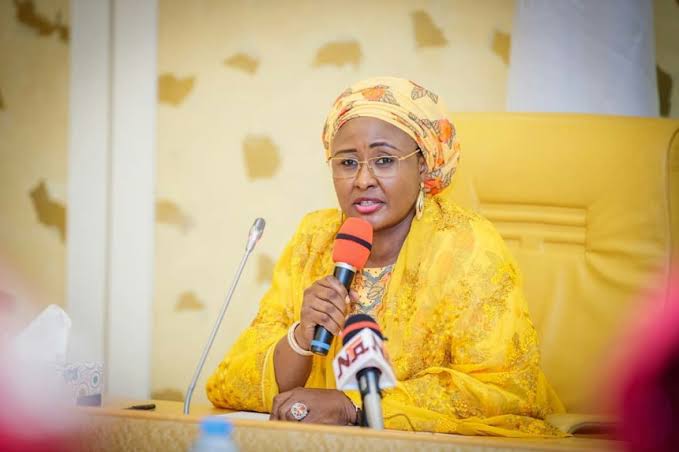
An investigative analysis of fear, power, silence, and Nigeria’s unresolved presidential health crisis
TRACKING TIMES
In a revelation that has reignited national and international debate, Aisha Buhari, widow of Nigeria’s late President Muhammadu Buhari, disclosed in a newly launched book—released three days ago in his honour—that her husband once suspected her of plotting to kill him and, as a result, began locking his room inside Aso Rock Villa.
Her admission reopens long-standing questions about Buhari’s 2017 health crisis. It also raises issues about the secrecy surrounding his treatment. Moreover, it highlights the internal power dynamics within the Presidency. Lastly, it brings up the competing narratives that Nigerians were told—or denied—during that period.
This article probe criminal conclusions. It examines the implications of Aisha Buhari’s testimony. It places Aisha Buhari’s testimony alongside earlier public assertions by Nnamdi Kanu. It also contextualizes Farooq Kperogi’s documented reporting on marital separation, all within Nigeria’s history of opaque governance.
What Aisha Buhari Actually Said
Aisha Buhari’s account in the book reveals significant rumours. These rumours circulated during President Buhari’s prolonged medical stay in the United Kingdom in 2017. They painted her as a threat to his life. She states:
“Then came the gossip and the fearmongering. They said I wanted to kill him. My husband believed them and started locking his room.”
She further explained that the atmosphere of fear allegedly altered Buhari’s daily routines:
- His room was locked from inside
- Eating patterns were disrupted
- Meals were delayed or skipped
- Nutritional supplements were stopped
Most strikingly, she claimed:
“For a year, he did not have lunch. They mismanaged his meals.”
Aisha Buhari also confessed that the President’s office was bugged. Private conversations were replayed to him. Fear, suspicion, and psychological pressure contributed significantly to his decline. She stated that fear and conscience “contributed to taking his life.”
These are her words, presented as personal testimony, not judicial findings or propaganda.
The 2017 Health Crisis Nigerians Never Fully Understood
In 2017, President Buhari spent months (over 153 days) in the United Kingdom receiving medical treatment. During that period:
- Nigerians were not informed of his exact condition
- Power struggles within the Presidency were widely speculated upon
- Access to the President was tightly controlled by the cabals
- Conflicting statements were issued by aides and officials (Lai Muhammed, Garba Shehu, Femi Adesina ) etc.
The nation was governed largely in absence, creating what analysts later described as a constitutional grey zone.
At the time, concerns raised by journalists, opposition figures, and civil society were dismissed as rumours or “anti-government propaganda.”
Aisha Buhari’s recent statements now expose that fear existed at the highest level of power. Internal distrust was real, not imagined. Internal distrust was real, not imagined.
ALSO READ & WATCH VIDEOS BELOW:
WATCH VIDEO:
Nnamdi Kanu’s 2017 Assertions: Context, or Confirmation?
During the same period, Nnamdi Kanu, leader of the Indigenous People of Biafra (IPOB), made public statements. He stated that President Buhari had either died or was incapacitated. He also claimed that Buhari was replaced by impostors.
Those claims were widely rejected by the Nigerian government and labelled misinformation. No court has validated them.
However, Aisha Buhari’s new disclosures introduce a parallel narrative:
- that Buhari’s health situation was far more severe than admitted
- that his environment was marked by fear, isolation, and mistrust
- that key decisions about his care have not been fully transparent
This possibly validate Kanu’s claims. It explains why such claims found an audience in the absence of clear official communication.
Silence, secrecy, and fear create space for speculation.
Watch Trending Video breakdown on Nnamdi Kanu news and life sentence updates:
Farooq Kperogi and the Question of Marital Separation
Professor Farooq Kperogi, a respected Nigerian-American academic and columnist, adds another layer to the narrative. He previously published that Aisha Buhari and Muhammadu Buhari were divorced or separated before his death.
Kperogi’s report, grounded in insider sources and personal communications, was controversial but never formally challenged in court.
When viewed alongside Aisha Buhari’s admission of deep mistrust, physical separation, and psychological warfare, Kperogi’s reporting gains renewed relevance. It is not as proof of wrongdoing. Rather, it serves as evidence of a fractured presidential household during a critical moment in Nigeria’s history.
The Bigger Issue: Nigeria’s Culture of Secrecy
This story is ultimately not about personal guilt.
It is about state secrecy and institutional failure.
Key questions remain unanswered:
- Who controlled access to President Buhari during his illness and questionable whereabouts in 2017?
- Who influenced the information he received about his wife?
- Who managed his medical care and nutrition?
- Why was the nation kept in the dark?
- Why were rumours allowed to thrive unchecked?
A democracy cannot function when the health of its leader becomes a classified mystery.
Why This Matters Today
Nigeria is still grappling with:
- distrust in leadership
- opacity in governance
- politicization of illness and death
- suppression of inconvenient truths
Aisha Buhari’s confession is not merely personal—it is historical.
It challenges Nigerians to confront uncomfortable realities about power and manipulation. It also highlights the human cost of secrecy at the highest level of government.
Conclusion: Testimony, Not Trial
This article does not accuse.
It does not convict.
It does not speculate beyond what has been publicly stated.
It documents testimony, published analysis, and historical context.
Aisha Buhari has spoken.
Others spoke years ago and were silenced or dismissed.
History now demands that Nigerians listen carefully. They should ask better questions. They must insist that no future president’s health—or life—be hidden behind walls of fear again.